

Education agents ask Immigration New Zealand to explain the gap, give clear reasons for refusals, and give genuine students a fair chance to respond
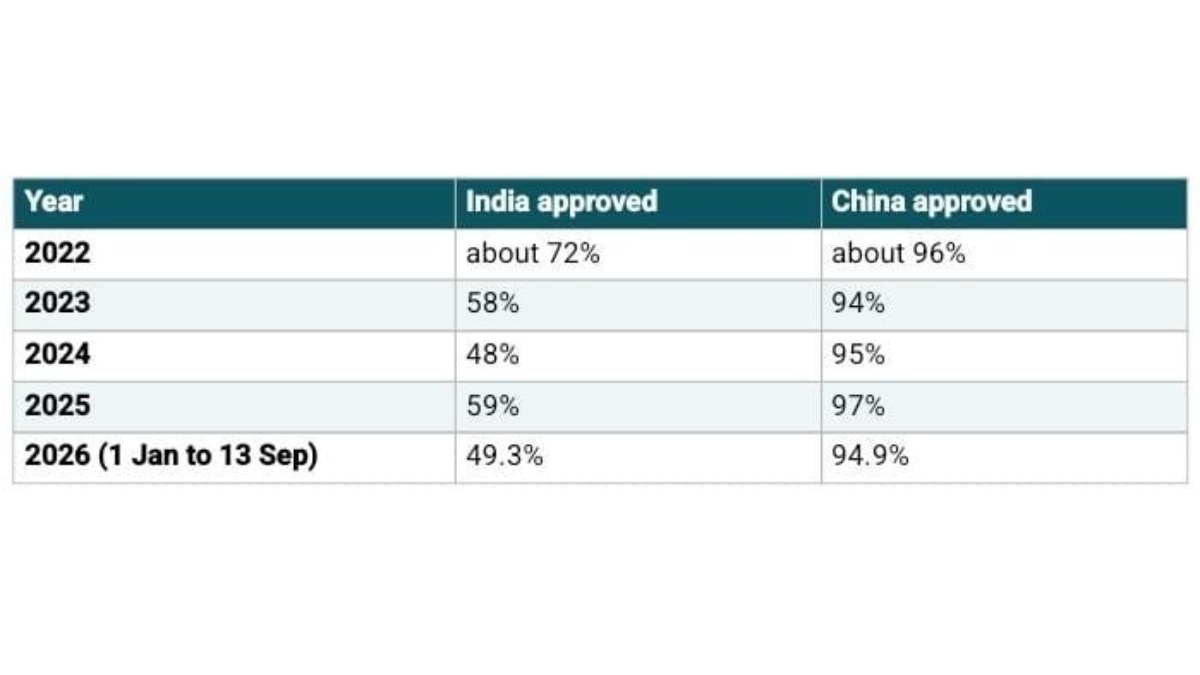
Auckland [New Zealand], October 6: Immigration New Zealand’s own figures show that approval rates for Indian student visa applicants from offshore have fallen sharply over five years, while China’s have stayed close to 95%. Education agents in India and New Zealand are now asking INZ to explain why, at a time when New Zealand and India are building closer education ties under their new trade agreement
What INZ’s own data shows
| Year | India approved | China approved |
|---|---|---|
| 2022 | about 72% | about 96% |
| 2023 | 58% | 94% |
| 2024 | 48% | 95% |
| 2025 | 59% | 97% |
| 2026 (1 Jan to 13 Sep) | 49.3% | 94.9% |
In 2024, INZ declined about 5,700 offshore applications from India, against about 430 from China, on a similar number of applications (11,338 and 10,996). In 2026 so far, India is the largest offshore market, with 8,463 applications, and China is a close second with 8,273.
Separate data obtained under the Official Information Act by the New Zealand Association of Migration Advisers, covering more than 100,000 student visa applications processed since August 2025, found 41.2% of offshore Indian applications were declined, against 2.4% for China. It also found that of the declined applications, 13% from India received a chance to respond to INZ’s concerns before the decision, against 50% for China.
INZ’s position
INZ says the gap reflects the mix of applications it receives, not its processing system. It says many Indian refusals come from funds requirements not being met, including false or misleading financial information, and that applications from complex markets such as Bangladesh have grown sharply. It also says it must balance requests for further information against productivity.
Agents accept that INZ must keep strong standards and stop fraud. They say the question is whether genuine students are being assessed fairly and consistently.
What agents report
The following are the agents’ own accounts. INZ has been invited to respond.
- Generic reasons. Genuine students, including 2026 school leavers with no gap, are refused without an interview, citing general concerns about their statement of purpose. Where interviews were held and agents say students performed well, which they hold recordings of, some visas were still declined.
- Inconsistent gap decisions. Students who finished Year 12 in 2025, with under a year’s gap, are refused for an “academic gap”, while agents say some 2024 school leavers with the same gap are approved. New Zealand institutions accept these students.
- “Future plans not justified.” Agents say this reason appears in most refusals, even when students explain how each subject links to their career, their post-study plans with named New Zealand employers, and their return plans with specific roles and salaries.
- Uneven funds assessment. Some applications are approved on recently held funds, while others with long-held family savings and a full explanation of their source are declined. Agents also ask how families can show that money held by parents for over a year will be available to the student, and suggest allowing funds to be deposited before the application, as some other countries do.
- Identical letters. One agent says a refusal was issued by one officer and, the next day, the same officer refused a colleague’s client, a different student with a similar profile, with the same reason in the same words.
- Reasons that don’t match. Agents say refusal letters now use a general format, and the real reasoning appears only in officer notes obtained later under the OIA. In one case, they say, the letter cited a “gap” that the student did not have, while the notes recorded another reason.
What industry voices say
Neeraj Luthra, Director of Indopacific Education Services, said he was raising serious concerns about what he described as an unprecedented level of student visa declines affecting Indian applicants, following what he described as a 1 August 2026 change in Immigration New Zealand’s approach to bona fide assessments. After more than 25 years of promoting New Zealand education in India, he said he had never seen this level of concern across the education sector, and that the current pattern has created a strong and growing perception of bias and differential treatment towards Indian applicants, particularly in bona fide assessments.
“The concern across the industry is increasingly straightforward: there is a perception that an ‘intent to decline’ approach is currently being applied to a significant number of Indian applications, rather than genuine applicants being given a meaningful opportunity to demonstrate their circumstances.”
He said genuine students with credible academics, genuine offers, documented finances and detailed study and career plans are facing refusals on broad or generic grounds.
“We are not asking for lower standards or preferential treatment. We are asking for consistent, transparent and evidence-based decisions, with every applicant assessed on their individual circumstances and evidence.”
Mr Luthra is calling for a senior quality-assurance review of recent Indian refusals, greater transparency around bona fide assessments and interviews, and stronger accountability across recruitment channels.
Pankaj Malhotra of Exodus Overseas said: “A student and their family put months of work, and often over a lakh of rupees, into one visa application, from choosing a course and preparing for IELTS to the offer, the loan and the wait for a decision. When a decision doesn’t appear to reflect the evidence provided, it affects their finances, their plans and their wellbeing. It also affects the agents who promote New Zealand, the universities, and New Zealand’s reputation as a fair destination. Many agents in India are now considering other countries for their students. We are simply asking for clear reasons and consistent assessment.”
Amarpreet, Director of Kiwiana Immigration & Education, said: “The issue is not whether Immigration New Zealand should maintain robust standards. It absolutely should. The question is whether genuine students are being assessed on the complete evidence available to the decision-maker, particularly where the circumstances are complex or where a concern could reasonably be clarified.
“For example, we recently dealt with a student whose visa was declined on the basis that his interview responses allegedly demonstrated limited knowledge and confidence. When we subsequently reviewed the interview recording, the answers appeared substantially more detailed and responsive than the reasons recorded in the decision suggested. In another case, a young applicant who had recently completed secondary education wanted to undertake a different undergraduate pathway based on his evolving academic and career plans. The application raised questions about genuine study intentions, but the applicant had provided a detailed explanation of why the proposed programme was relevant to his circumstances.
“If two of New Zealand’s largest student markets are being assessed under the same framework, a gap of this magnitude should at least prompt us to ask why the outcomes are so dramatically different.”
Jagjit Singh Chans, Director of Medway, said: “From our experience, we are increasingly concerned about the level of scrutiny faced by Indian student applicants, particularly around funds, education loans, bona fide intentions and interview expectations. In cases where genuine concerns arise, applicants should be given a fair opportunity through the PPI [potentially prejudicial information] process to clarify or provide further evidence before a final decision is made. The patterns we have observed in recent months raise legitimate questions about consistency and whether Indian applicants are being subjected to a different level of scrutiny. If New Zealand is serious about growing its international education sector, it is important that Indian students have confidence in a transparent, consistent and evidence-based assessment process.”
A larger number of agents joined the call for INZ to explain recent refusals . Agents warn that continued refusals, and a lack of clear reasons, risk damaging New Zealand’s reputation as a fair and welcoming study destination in India. They also say the refusal rates risk undermining the goodwill that the new India-New Zealand trade agreement is meant to build.
What agents are asking for
- Clear, case-specific reasons in every refusal letter.
- A fair chance to respond or verify documents before a decision is made.
- Consistent, published guidance on gaps, funds and future plans.
- Public reporting of refusal reasons by nationality, so the sector can see whether the pattern is about funds, fraud or something else.
- A clear review process where the recorded reason appears to conflict with the evidence.
Media contact: Varsha Marathe /9370220270/ Aaspire Communications
Notes to editors: INZ figures are from its published offshore student visa decision data (2022 to 2025) and its September 2026 agent webinar. The 2022 rates are calculated from INZ’s approved and declined numbers, and published rates exclude withdrawals. Case descriptions are agents’ accounts, and INZ has been invited to comment.
If you object to the content of this press release, please notify us at pr.error.rectification@gmail.com. We will respond and rectify the situation within 24 hours.
