

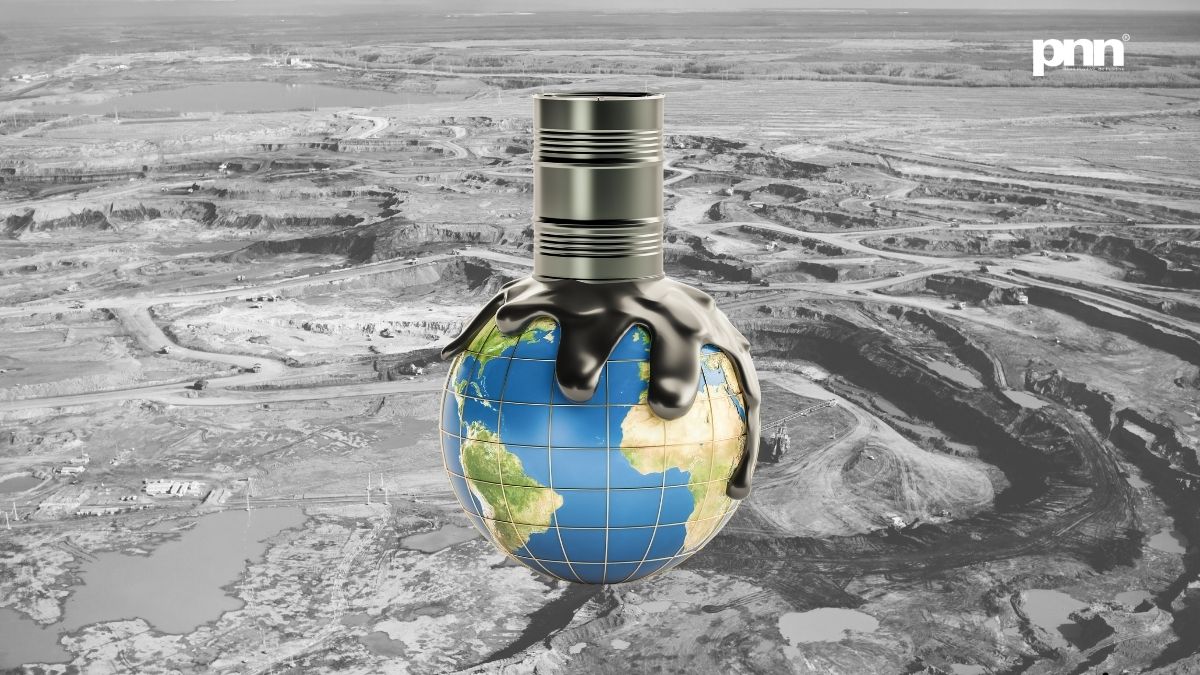
New Delhi [India], March 14: Crude oil still runs the world. Not quietly either. It’s loud, messy, political, expensive, and weirdly unavoidable.
Oil is still right at the heart of the global economy even in 2026, when the climate conferences, electric car advertisements, and governments use such phrases as energy transitions have taken place. Ships run on it. Planes absolutely need it. Plastics come from it. A supermarket shelf has half of its items that have their source in a barrel of crude in the Middle East, the United States, or offshore Brazil. Individuals like to fantasize that we are already relinquishing oil, but the truth is that we are not. Not yet.
Look at the numbers for a second.
The global community is presently using about 100 million barrels of oil daily. That’s not a typo.. One hundred million. Daily. And weirdly enough, demand hasn’t collapsed the way some forecasts predicted a decade ago. If anything, global consumption has stayed stubbornly high. The International Energy Agency has repeatedly pointed out that oil demand keeps growing in developing economies, such as India, Southeast Asia, and parts of Africa, because industrialization simply requires enormous amounts of energy.
And induction changes… it takes time. A lot of time.
Consider it as infrastructure inertia. When many millions of gasoline cars are built, and thousands of refineries, and cross-continental pipelines, and petrochemical plants to supply whole manufacturing sectors, you do not just turn the switch and put thousands of refineries in place. It is as though attempting to change the direction of a cargo ship in the sea. Possible, yes. Fast? Not even close.
Take transportation, for example.
Electric vehicles get all the headlines, and sure, EV adoption is rising quickly in countries like China, Norway, and the United States. But the global car fleet today still includes more than 1.4 billion vehicles, and the overwhelming majority run on petrol or diesel. Even if every new car sold tomorrow were electric—which obviously isn’t happening—it would still take maybe 15 to 20 years for the existing fleet to gradually disappear.
And that’s just cars.
Aviation is a completely different beast. Jet fuel has an energy density that batteries simply can’t match right now. A fully electric long-haul aircraft? Engineers are working on it, but commercially viable versions are probably decades away. Airlines burn around 7–8 million barrels of oil per day, and that demand isn’t vanishing anytime soon.
Shipping too. Cargo ships carry about 90% of global trade, most of it powered by heavy fuel oil or marine diesel. Alternative fuels like ammonia or green methanol are being tested, but scaling those technologies across tens of thousands of vessels will take—honestly—years and years.
Then there’s petrochemicals. And this is where things get interesting.
People often think of oil mainly as fuel. Gasoline, diesel, jet fuel. But roughly 12–15% of global crude oil demand goes into petrochemicals, which means plastics, fertilizers, synthetic fibers, detergents, medical equipment, packaging… the list goes on forever. Your phone casing? Oil. Polyester clothing? Oil. Many pharmaceuticals? Also oil.
This part of the demand is actually expected to keep growing, even in aggressive clean-energy scenarios. Because as incomes rise globally, people consume more manufactured goods. More packaging. More electronics. More everything.
So… how long will people depend on crude oil?
Most serious energy forecasts, IEA, OPEC, BP, the big consulting firms, tend to land on a similar uncomfortable answer: oil will remain a major energy source until at least 2040 or 2050. Maybe longer.
But here’s the subtle thing many headlines miss. Dependence doesn’t disappear suddenly. It fades slowly.
Coal, for instance, peaked in many Western countries decades ago but still hasn’t vanished entirely. Oil will likely follow a similar pattern. Demand will eventually plateau. Then decline. But it’ll be a long slope downward, not a cliff.
India is a good example of why.
The energy needs of the country are increasing at an unbelievable rate with the growth of the cities, the development of industries and the entrance of several millions of people into middle classes. India has been consuming oil at an almost annual rate. Sure, electric mobility is increasing, but trucks, buses, and construction machines are too much dependent on diesel. And with the continuing growth of the economy, fuel demand tends to trail.
So while Europe may gradually reduce oil use, other regions are still ramping it up. Global demand ends up balancing out.
There’s also geopolitics. And honestly… this part always complicates things.
Wars, sanctions, OPEC actions, shipping shocks and financial speculation play with oil markets. An outbreak of war in the Middle East, embargo on Russian exports or a Saudi shutdown can push prices overnight. Governments understand this and that is the reason why most nations do not want to give up oil too fast. Energy security matters. A lot.
Right, so here’s the uncomfortable reality.
The world is establishing itself without crude oil. Renewable energy grows at an accelerated pace solar, wind, battery storage, all the hydrogen experiments, etc. There is an increasing number of electric vehicles. Carbon targets are being established by governments.
The transformation is not a straight line. It’s messy. Delayed here and fast here. And of a huge industrial ecosystem centuries old, crude oil is the heart.
As most observers can decipher, the global oil demand may reach its peak in the late 2030s or early 2040s. Then it is possible that it will gradually decrease as clean energy becomes larger. However, the world is also likely to continue consuming tens of millions of barrels per day even in 2050.
Not because people love oil.
Because replacing it everywhere, all at once, is just… really, really hard.
And honestly? Anyone promising a quick, painless exit from crude oil is probably oversimplifying things. The global energy system is massive. Complex. Sticky. You pull one thread, and suddenly, airlines, plastics, fertilizers, shipping, and power grids are all tangled together.
So yeah. Oil’s era isn’t ending tomorrow.
But it is slowly, awkwardly, maybe inevitably… beginning to fade. Just not as fast as people sometimes hope. Or fear.
