

Mumbai (Maharashtra) [India], October 3: GST 2.0 aimed to simplify taxation and support education. But India’s notebook manufacturers now face rising costs, blocked tax credits, and tougher competition from imports.
Reform with Unintended Consequences
The rollout of GST 2.0 was welcomed by industry as a bold reform designed to streamline taxation and reduce compliance burdens. For education-related goods, the government made a significant move: setting the GST rate on notebooks at 0%.
The intention was straightforward: make learning more affordable. Yet, the notebook manufacturing sector is experiencing unforeseen challenges as a result.
Imports Gain an Edge
Under the ASEAN Free Trade Agreement, imports from Indonesia, Thailand, and Malaysia already arrive in India at 0% customs duty. With GST 2.0 setting notebook GST at 0%, these imports now attract no IGST either.
The outcome: imported notebooks can land in India completely tax-free; domestic notebooks, by contrast, face production costs inflated by input taxes.
The Input Credit Blockage
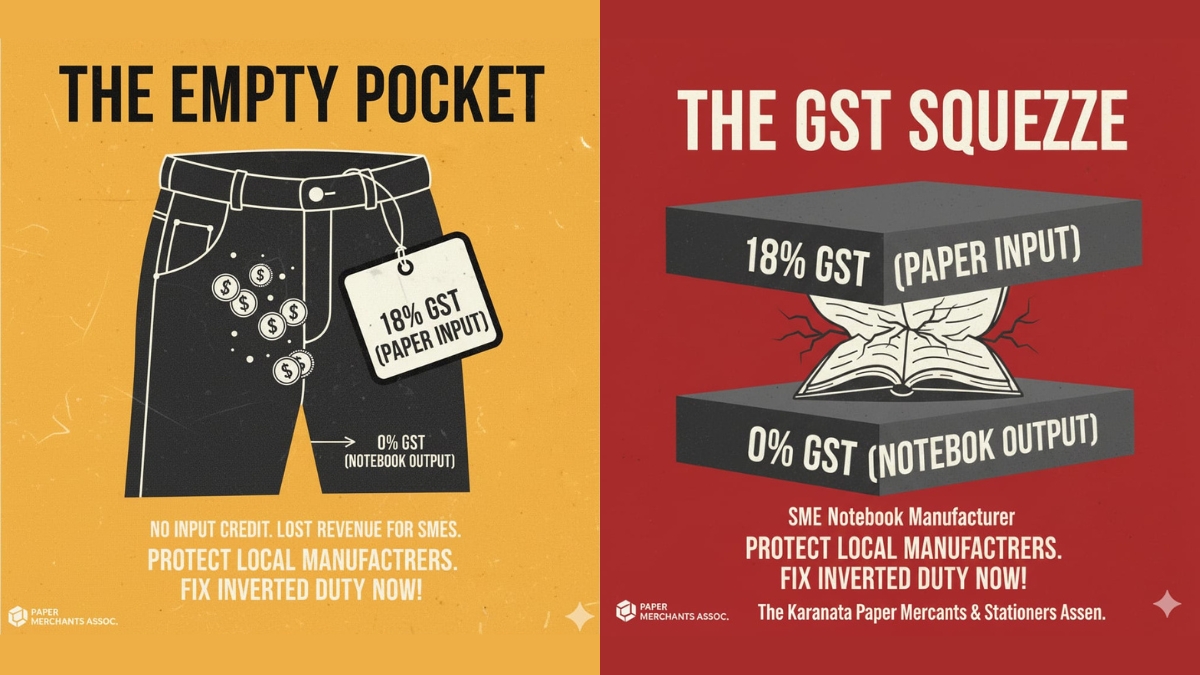
Notebook manufacturing relies heavily on raw materials, including coated paperboard, packaging films, adhesives, and wires. These inputs attract 18% GST.
Previously, Indian notebook makers could balance this by claiming input tax credit (ITC). But with final notebooks taxed at 0%, there is no ITC mechanism available. This leaves manufacturers bearing the full burden of GST on raw materials.
This tax mismatch has become the central concern for domestic producers.
Rising Costs vs Flat Prices
While the GST reduction was expected to lower notebook prices for students, the opposite trend is visible in the market. Prices are climbing, mainly because manufacturers must absorb higher raw material costs without the benefit of ITC relief.
Cheaper imports from ASEAN countries add another layer of pressure, creating a dual challenge for India’s small and medium notebook makers.
Small-Scale Industry at Risk
The notebook sector is dominated by MSMEs across India, many located in semi-urban and rural areas. These businesses are typically labour-intensive, employing hundreds of thousands of workers, often women and youth.
Higher costs, blocked ITC, and import competition threaten their viability. If left unaddressed, the consequences could include:
- Job losses across rural belts.
- Closures of small units, which are already operating on tight margins.
- Loss of investments in domestic manufacturing.
- Greater import dependency, despite India’s capacity to meet demand.
Imports from Indonesia: A Case in Point
Indonesia is the world’s largest producer of paper and paper products. With duty-free access under ASEAN agreements, its exports pose a substantial competitive threat to India’s local players.
For domestic producers, the concern is not about efficiency or productivity. India already has sufficient capacity to meet its own notebook demand. The issue is purely cost competitiveness under the current tax regime.
Industry’s Representation to Government
The All India Notebook Manufacturers Association (AINMA) – booksmanufacturersassociation@gmail.com – has conveyed its concerns to policymakers, including the Union Ministry of Commerce and the GST Council.
In its representations, the Association has requested:
- Examination of input tax credit (ITC) mismatch, by maintaining a nominal GST rate on notebooks, would enable ITC to flow back to manufacturers.
- Anti-dumping or safeguard measures on imports, to ensure a level playing field for domestic producers.
Review of raw material GST rates, particularly for coated paperboard, which has recently been increased from 12% to 18%.
The Association emphasises that the objective is not to oppose GST reforms, but to ensure that benefits reach students without damaging local industry.
Protecting Education and Employment
Notebook manufacturing is unique in its dual contribution: it supports India’s education ecosystem while also sustaining rural employment. Any disruption here impacts both access to affordable learning materials and livelihoods.
The sector argues that aligning GST structures to restore competitiveness would ensure that:
- Students benefit from stable or lower notebook prices.
- Manufacturers remain viable and continue to provide employment.
- India maintains its self-reliance in an essential product.
Balancing Reform and Industry Needs
GST 2.0 represents a milestone in India’s tax landscape. But like many broad reforms, it has sector-specific ripple effects. The notebook industry is one such case.
The challenge before policymakers is to balance two priorities: making education affordable and protecting domestic MSMEs. Both objectives are achievable, provided adjustments are made to address ITC blockages and import parity issues.
The Way Forward
Policy dialogue between industry associations and government is already underway. Possible measures could include:
- Reintroducing a nominal GST rate on notebooks, enabling ITC benefits.
- Monitoring import flows and, if necessary, applying anti-dumping duties.
- Reviewing GST rates on raw materials critical to notebook manufacturing.
Such steps would align with both the spirit of GST reforms and the goals of “Make in India.”
Conclusion
The notebook sector’s concerns highlight an important lesson in tax reform: well-intended measures can create unintended pressures when sectoral dynamics are not fully aligned.
GST 2.0 has simplified taxation and supported education on many fronts. For the notebook industry, however, relief measures are urgently needed to ensure that affordability for students does not come at the cost of domestic employment and industry sustainability.
