

Mumbai (Maharashtra) [India], July 21: Open an economics textbook and you’ll get a clean, reassuring story: investors crunch numbers, weigh the options, and always chase what makes them the most money. But talk to anyone who lived through the crash in 2008—or someone who piled into GameStop at $400—and you’ll get a very different picture. Markets aren’t run by algorithms. They’re run by people. People get nervous. People get greedy. Sometimes people are their own worst enemy.
That messy gap between the supposedly “rational investor” and the real person just trying not to panic while their account balance bleeds? That’s where behavioral finance comes in. Back in the 1970s, psychologists Daniel Kahneman and Amos Tversky started connecting the dots with their research, and economists like Richard Thaler picked up the ball. Their big point isn’t complicated: markets don’t just run on numbers—they run on fear, greed, memory, and ego, too.
Loss Aversion: Losing Hurts Way More Than Winning Feels Good
Kahneman and Tversky called it prospect theory. In plain English: losses hurt about twice as much as wins feel good. This one bit of psychology explains a ton of investing “mistakes” people make every single day.
Just look at the disposition effect. Investors cash out winners too quickly but hang on for dear life to their losers, hoping those stocks rebound. Nobody wants to admit defeat, so people wait—sometimes forever—until a small loss snowballs into catastrophe. Plenty of folks rode Enron or Lehman Brothers all the way down, convinced salvation was just around the corner.
Herd Behavior: The Crowd Isn’t Always Right
Nobody wants to be left out, least of all when money’s on the table. When everyone around you is piling in and bragging about gains, sitting it out feels reckless—even if things don’t add up.
Think back to the dot-com bubble. Money flooded into companies with no profits and, honestly, no real business sometimes. Stocks soared because everyone else was still buying. There’s a reason Pets.com raised $80 million and then disappeared in under a year. Jump ahead to 2021 and you see the same story with new faces—GameStop and AMC, supercharged by Reddit’s WallStreetBets. GameStop exploded over 1,600% in weeks. Did the company suddenly become incredible? Nope. It was the hype, not the fundamentals.
Overconfidence: We All Think We’re Warren Buffett
Here’s a hard truth—most investors think they’re smarter than average. That can’t be right, but overconfidence is a real force. It pushes people to trade too often, put everything into one idea, or take risks they shouldn’t.
Long-Term Capital Management is the blueprint for overconfidence gone sideways. Nobel Prize winners started it. Supposedly, they had unbeatable models. In 1998, a crisis in Russia blew a hole right through those models, and the fund nearly took the global financial system with it. Even the smartest folks fall into this trap—believing their model can’t fail.
Anchoring and Confirmation Bias
Investors get stuck on random anchors. Like, whatever price they paid for a stock becomes their hill to die on. After that, they only look for news and opinions that back up their choice. So if you bought Tesla at $900, you cling to that number, ignore anything scary, and hunt for headlines that make you feel better.
This gets worse when markets are turbulent. Instead of stepping back, people keep searching for anything that says, “Don’t worry, you’re right.” Instead, they need a hard look in the mirror. That wait-and-hope approach can make little mistakes grow into big, expensive ones.
Fear, Greed, and Market Rollercoasters
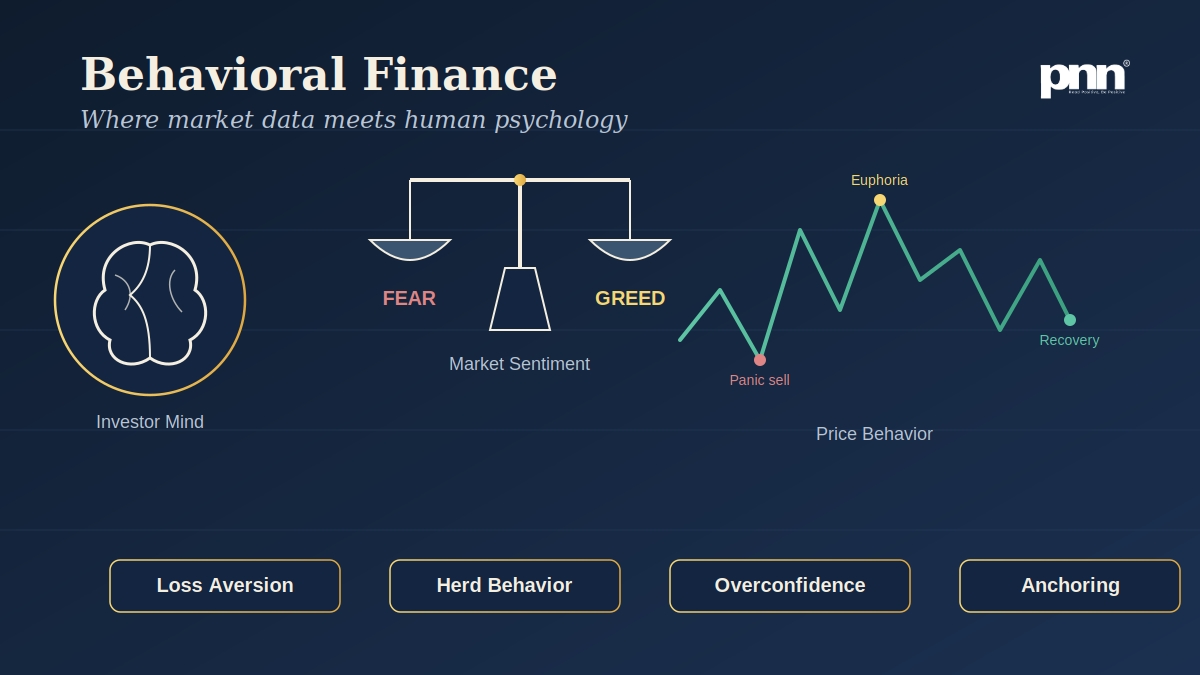
Want proof that psychology moves the market? Just watch it swing between total panic and wild euphoria. In 2008, it wasn’t all about bad mortgages—fear turned into a full-blown stampede. Prices tanked, everyone rushed to sell, and the S&P 500 lost over half its value from 2007 to March 2009. Eventually, when the fear faded, the market rocketed back.
Warren Buffett puts it simply: “Be fearful when others are greedy, and greedy when others are fearful.” That sums up behavioral finance. Most people do the opposite—they buy at peaks, then sell in a panic.
How to Outsmart Your Own Mind
Just knowing you’re wired for these mistakes doesn’t solve them, but you can at least give yourself a fighting chance:
- Automate parts of your investing, like using dollar-cost averaging, so emotions don’t get in the way.
- Write down why you’re buying a stock before you pull the trigger. Later, you’ll be able to compare the story you told yourself with what actually happened.
- Figure out your selling rules ahead of time, not in the middle of a panic, so you don’t let fear drive your choices.
- Diversify for real—don’t just believe your “sure thing” is actually safe.
The Bottom Line
Markets don’t just reflect profit and loss—they mirror our minds. The best investors aren’t just crunching numbers; they’re keeping themselves honest. Spot your own mental traps before they empty your wallet. Because, honestly, your biggest risk probably isn’t some black swan event. It’s you.
