

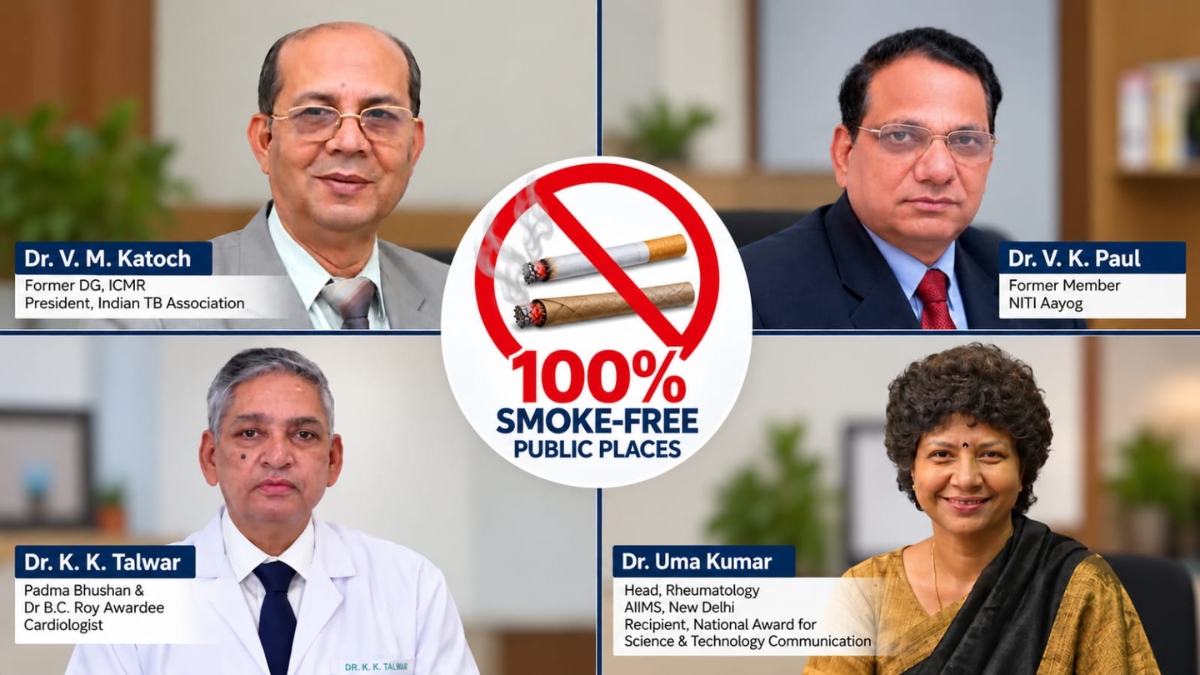
New Delhi [India], October 3: India needs to move towards 100% smoke-free public places to protect millions from second-hand smoke, leading health experts said, citing an estimated 3.25 lakh deaths every year in the country attributable to passive smoking. They said non-smokers exposed to tobacco smoke can suffer serious health consequences and called for stronger protection against involuntary exposure, including by moving beyond designated smoking areas towards completely smoke-free public environments.
Dr. V.K. Paul, former Member of NITI Aayog, said India had made progress in reducing exposure to second-hand smoke, but the scale of the remaining problem was still substantial. Referring to a recently published Global Burden of Disease study in The Lancet Public Health, Paul said the proportion of India’s population exposed to second-hand smoke had declined from 43 percent in 1990 to 31 percent, but the absolute burden remained high because of population growth.
“Second-hand smoke exposure is still happening. In 1990, 43 percent of India’s population was exposed to second-hand smoke. This has now come down to 31 percent,” Paul said. “But because the population has increased, the problem is still very large. Globally, 1.7 million deaths are occurring because of second-hand smoke. In India, more than 3.25 lakh deaths are attributable to second-hand smoke,” he said.
Paul said the Indian burden included around 1.5 lakh deaths among women and nearly 1.75 lakh among men. He stressed that India needed to move towards 100% smoke-free public places. The comments came at a webinar organised by Tobacco Free India, a citizen-led initiative working towards a tobacco-free India, on the need to strengthen protection against second-hand smoke. The webinar was among the first major public conversations in India on second-hand smoke following the publication of the new Lancet Public Health study.
Held on October 2, Gandhi Jayanti, the discussion also marked 18 years since India’s smoke-free public places rules came into force. It was moderated by health communicator Mukesh Kejriwal.
Dr. Uma Kumar, Head of Rheumatology at AIIMS, New Delhi, and recipient of the National Award for Science Communication, said the scale of exposure highlighted the need to protect people who did not use tobacco but were exposed to smoke around them. Referring to the Lancet Public Health study, Kumar said the findings made second-hand smoke a major public health concern, particularly for women and children who may have limited control over the environments in which they live, work, or spend time.
The study estimates that around 444 million Indians were exposed to second-hand smoke in 2023, while 325,600 deaths were attributable to such exposure. Its estimates include exposure at home and workplaces and do not capture exposure occurring exclusively in some other settings.
Former ICMR Director General and President of the Tuberculosis Association of India, Dr. V.M. Katoch, said passive smoking had well-established health consequences and affected people not only in public spaces but also in workplaces and homes. “Passive smoking is very dangerous. It has been proven by many studies and has a substantial impact. People are affected in public places, workplaces, and even in their homes,” Katoch said. He said the effects were not confined to the respiratory system.
“Those who are exposed to smoke experience similar harmful effects. Their respiratory system is damaged and different organs of the body are affected. Over a period of time, it becomes equally harmful,” he said.
Katoch said India needed to bring smoking in public places down to zero. At the same time, he stressed that action against second-hand smoke should extend to homes, where children and other non-smokers may have little control over their exposure.
Padma Bhushan awardee and recipient of the Dr. B.C. Roy National Award, cardiologist Dr. K.K. Talwar, said India had already taken several measures to discourage tobacco use, including taxation and prominent health warnings on tobacco products. He said passive smoking exposed non-smokers to health risks even when they had never used tobacco themselves. “Even if you don’t smoke and somebody else is smoking, you also become a smoker. It can be as harmful as active smoking,” Talwar said. “This is one of the reasons why public places should be entirely smoke-free,” he said.
Paul said, however, that the ultimate objective needed to go beyond protection from second-hand smoke and focus on eliminating tobacco use itself. “India needs to be tobacco-free, not just free from second-hand smoke. There should be no smoking and no chewing tobacco. Both have harmful effects,” he said.
He said India needed to prevent tobacco addiction among the next generation, including by ensuring that tobacco was not easily available around educational institutions. “The ultimate goal is that there should be no tobacco consumption and no addiction. Tobacco should not be available anywhere near schools. We have to protect the next generation from this deadly habit and its harmful effects,” Paul said.
Kumar also called for India to move beyond designated smoking zones. After years of implementing smoke-free rules, she said, India should take progressive steps towards completely smoke-free public environments and reconsider the need for designated smoking areas. Women and children, she noted, were among those who could be involuntarily exposed to tobacco smoke.
India’s Prohibition of Smoking in Public Places Rules came into force on October 2.
If you object to the content of this press release, please notify us at pr.error.rectification@gmail.com. We will respond and rectify the situation within 24 hours.
