

Startups like FinSoftAI are showing how actual narrative intelligence can drive markets and influence price.
For decades, investors competed for access to information. Today, information is everywhere. The challenge is no longer finding data. It is deciding what matters. Investors are exposed to an unprecedented volume of information every day. Earnings calls, analyst reports, news, blogs, podcasts, Reddit threads, social media commentary, and search trends all feed a constant stream of competing signals for attention. But with more information than ever at their fingertips, markets continue to surprise investors. At FinSoftAi, that observation led us to a simple question: if data is abundant, why is actionable intelligence still so scarce? We believe the answer lies in the difference between information and narrative. We had seen it ourselves—narratives moving stocks days before the earnings or the data caught up, but we could not find a tool that systematically captured it. So we built one.
What Is Narrative Intelligence?
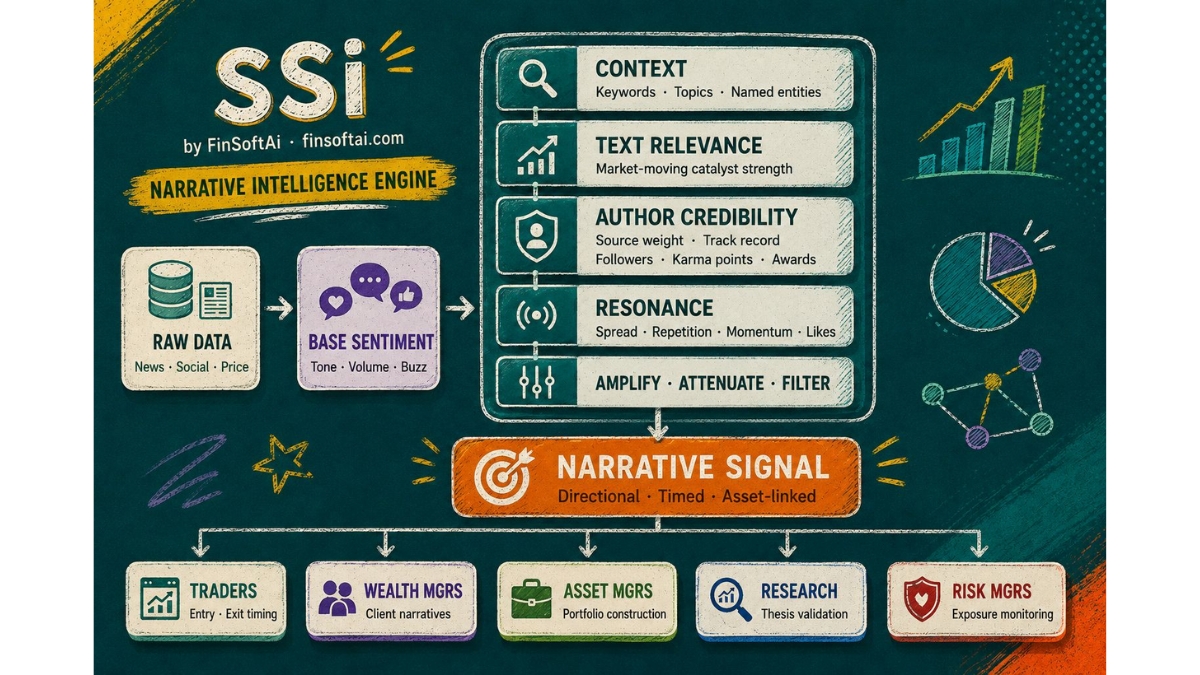
Traditional sentiment analysis attempts to answer a relatively simple question: How do people feel? Narrative Intelligence attempts to answer a more difficult one: Why does that sentiment matter? We often describe Narrative Intelligence as the layer that sits between raw information and investment decisions. To operationalize this, we built SSi around a framework that evaluates every piece of content through four lenses: Context, Relevance, Credibility, and Resonance.
Context identifies the keywords, topics, and named entities that anchor a piece of content to a specific company, sector, or market theme. Text Relevance assesses the market-moving catalyst strength of that content, distinguishing between noise that merely references a company and information that could genuinely shift investor expectations. The last two factors are where SSi diverges most sharply from conventional sentiment tools. Author Credibility weights the source based on track record, followers, and platform authority, ensuring that a seasoned analyst or high-reach institutional voice carries more signal weight than an anonymous comment. Resonance measures how far a narrative is spreading by tracking repetition, momentum, likes, and cross-platform reach to identify whether an idea is gaining or losing traction among the investor community.
Together, these four factors allow SSi, FinSoftAi’s Narrative Intelligence platform, to amplify, attenuate, or filter news and social content based on source credibility, audience reach, and engagement signals including followers, likes, comments, and shares. The result is a system that converts raw information into actionable signals rather than simply aggregating it, ensuring that a narrative gaining traction among informed, high-reach voices carries greater weight than noise from low-credibility sources.
The timing of Narrative Intelligence is not coincidental. Five years ago, the raw ingredients existed, but the means to process them at scale did not. Today that has changed. The volume of unstructured text data has grown exponentially, from filings and analyst notes to social media commentary and news. Generative AI can now reason over that text at scale, extracting meaning rather than merely counting keywords. Social media has become a primary channel through which market narratives form and spread, accelerating the speed at which investor expectations shift. And the rise of retail participation has added an entirely new layer of narrative-driven market behavior that traditional models were never designed to capture. Together, these forces have created both the need for Narrative Intelligence and, for the first time, the technical means to deliver it.
Why Markets Move on Narratives
A recent example can be found in the discussion around Agentic AI. For years, most AI infrastructure conversations focused almost exclusively on GPUs. More recently, a different narrative has started gaining traction. As AI systems become more autonomous and capable of executing increasingly complex workflows, some analysts have argued that CPU demand could become equally important. This narrative contributed to a meaningful re-rating of companies like Intel ($INTC), where investor expectations around CPU relevance began shifting well before any fundamental validation arrived.
At roughly the same time, a second narrative emerged around bare-metal infrastructure as enterprises explored on-premise AI deployments for reasons ranging from security to cost efficiency. Dell ($DELL) was among the companies that benefited as that conversation gained traction among investors and analysts, again ahead of the earnings cycle.
The same pattern played out with memory. As AI inference workloads scaled and on-device AI began demanding significantly more memory bandwidth, a narrative around HBM and next-generation memory demand started reshaping the investment thesis for Micron ($MU), with some analysts beginning to frame a path toward a trillion-dollar valuation long before those volumes appeared in guidance.
“What struck us was not that narratives moved markets. It was how consistently they moved prices before the data did. Once you recognize that pattern, the question is no longer whether narratives matter but how to measure them,” says Shailendra Abhyankar, Founder and CEO of FinSoftAi.
Why We Trade Live: Four Reasons Behind the Decision
Rather than relying exclusively on backtests, we chose to evaluate our ideas in live markets through SSi. This was a deliberate decision, driven by four reasons.
- First, trading with real capital in live markets creates feedback loops that no simulation can truly replicate. Every live trade becomes a product improvement opportunity.
- Second, by trading the same signals our customers will use, we place ourselves directly in their shoes. That experience builds genuine credibility in customer conversations.
- Third, live trading is also a product discovery exercise. It reveals where SSi performs strongest and where it needs further refinement, insights that directly inform how we design pilot engagements for clients.
- Fourth, real trades produce real proof points. A live performance track record carries weight in both investor and client conversations in a way that no backtest or theoretical model ever could.
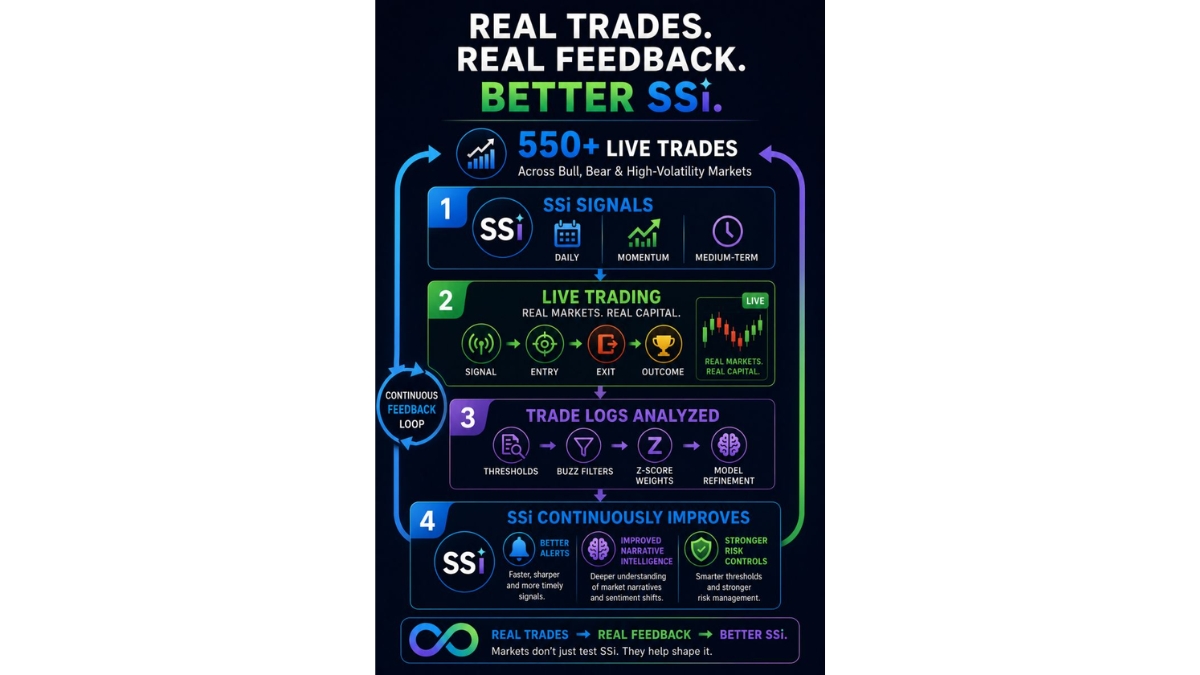
Real Trades. Real Feedback. Better SSi — The Continuous Improvement Loop
Over the last year, SSi-generated signals have been tested across 550+ live trades spanning bull, bear, and high-volatility market environments. SSi outperformed both the S&P 500 and QQQ benchmarks during the most recent three-month optimized phase. More importantly, the exercise demonstrated that narrative signals can be systematically tested, measured, and improved through real-world market participation rather than relying solely on theoretical models or historical backtests.
Every trade became feedback. Winning trades helped validate parts of the framework. Losing trades often proved even more valuable because they highlighted where narratives were weaker than expected, where market attention shifted unexpectedly, or where signal quality needed improvement. Those learnings have become one of the most important inputs into the ongoing evolution of SSi. This leads to an endless cycle of observation, testing, refining, and improving rather than a static model frozen in time.
The Future of Investing: Beyond Fundamentals and Technicals
For decades, investors have relied primarily on two lenses. Fundamentals provide hindsight. Technicals provide confirmation. AI is now making a third lens increasingly practical, one that offers something neither of the other two can: insight into what the market believes may happen next, before it happens. The future of investing will belong to those who can combine all three.
The Next Layer of Market Intelligence
For decades, investors searched for better data. The next decade may belong to those who can better understand the narratives hidden within that data. At FinSoftAi, our goal is not simply to build better sentiment analysis. It is to build a new layer of market intelligence that helps investors understand why information matters, how narratives grow and change, and when those narratives begin influencing markets.
Fundamentals tell you what something is worth. Technicals tell you how the market is behaving. Narrative Intelligence tells you what the market believes is about to happen.
Three lenses. One edge.
At FinSoftAi, we are building SSi to make that third lens as rigorous and actionable as the other two, because in a world where narratives move markets, seeing them clearly is no longer optional.
Shailendra Abhyankar is the Founder and CEO of FinSoftAi Solutions, and Nitin Menavlikar is the Co-Founder. FinSoftAi is building SSi, a Narrative Intelligence platform for capital markets, backed by NVIDIA Inception, AWS Activate, Wadhwani Propel, and Razorpay Rize.
